

Skill gives you power. Taste decides how you use it.
Skill opens doors. Taste decides which ones you walk through.


There’s this moment in a career that nobody talks about.
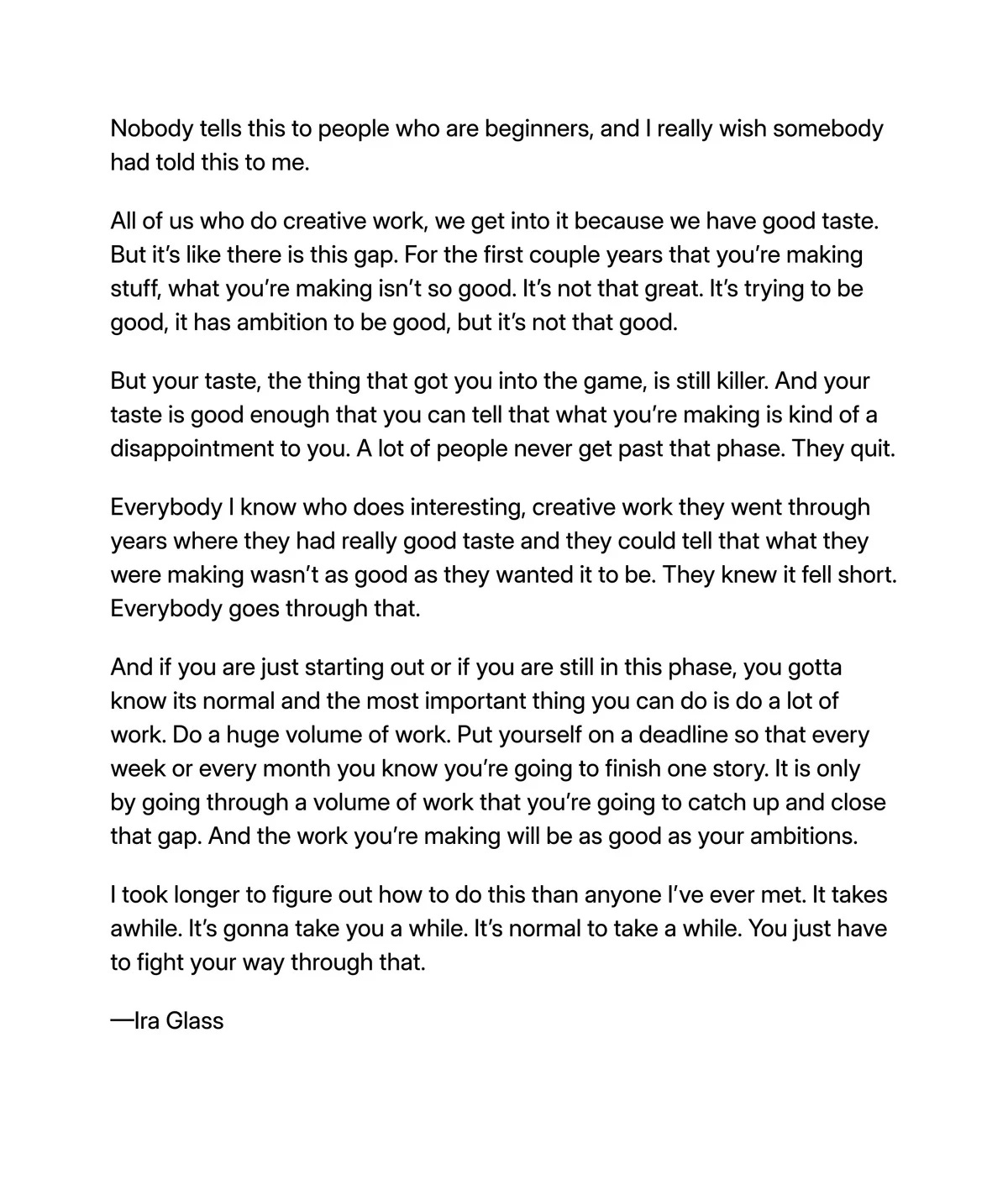
It’s not the beginning when you’re struggling to make anything good. Ira Glass covered that beautifully. And it’s not the middle, when you’re grinding through volume trying to close the gap between what you can make and what you can recognize as good.
It’s what comes after.
You’ve been doing this for 10, 12, 15 years. The work is finally good. You ship things that work. People trust your judgment. Execution isn’t the bottleneck anymore.
And then you notice something strange: the constraints that used to hold you back have mostly disappeared. You can execute almost anything you imagine. You have leverage. You have speed. You have power.
That’s when a different kind of pressure shows up. One nobody warned you about.
Early on, you’re limited by what you can do.
Later, you’re limited by what you’re willing to do.
The gap Ira Glass talks about eventually closes
Ira Glass gave us one of the most honest descriptions of creative development ever recorded. The taste gap – where your ambition outpaces your ability. Where you can recognize good work but can’t make it yet.
He says:
“All of us who do creative work, we get into it because we have good taste. But it’s like there’s this gap. For the first couple years that you’re making stuff, what you’re making isn’t so good. It’s not that great. It’s trying to be good, it has ambition to be good, but it’s not that good.”
And his advice is right:
Do a huge volume of work
Put yourself on a deadline
Fight through it
That phase is real. Most people quit there.
But here’s what Glass doesn’t address: What happens when you stop quitting? What happens when skill finally catches up?
Ira Glass explains why beginners suffer.
He doesn’t explain what happens when they stop.
What changes when skill arrives
When skill matures, the world opens up. You can execute almost anything you imagine. Constraints loosen. What used to take weeks takes days. The voice in your head that said “I can’t make this work” gets quieter.
New realities emerge.
You’re asked to ship faster – because you can. You’re rewarded for results, not judgment. You’re trusted to “figure it out” without much oversight.
Senior designers aren’t blocked by how to do something. They’re deciding whether.
And that’s where it gets interesting. Because skill doesn’t just remove friction. It creates opportunity. The opportunity to take shortcuts. The opportunity to ship something that works but doesn’t sit right. The opportunity to build things you know you’ll regret – but nobody will ever trace back to you.
Skill removes friction. It doesn’t remove responsibility.
Taste after competence
In the beginning, taste is diagnostic. It tells you what’s wrong with your work before you can fix it. That’s the gap.
After competence, taste becomes something else. It becomes directional. Taste is what tells you when something is possible – but shouldn’t be done.
I’ve felt this dozens of times working on enterprise platforms. You know the solution would “work.” It would ship. It would pass review. The metrics would move in the right direction. And yet. Something doesn’t sit right. The experience feels thin. The system loses coherence. You’re offloading complexity onto users instead of absorbing it yourself.
You could build it. Nobody would stop you. Most wouldn’t even notice.
But taste notices.
Taste shows up as discomfort with shortcuts. Resistance to “good enough.” A gnawing awareness of second-order effects that won’t surface for months.
It’s not perfectionism. Perfectionism is about polish. Taste is about structure. About trade-offs you can feel but can’t always articulate.
When you’re junior, taste makes you frustrated with your own work. When you’re senior, taste makes you cautious with your own power.
Silicon Valley as a case study
There’s a piece from Working Theory called “Taste Is Eating Silicon Valley” that names something important: taste can be eroded by systems that don’t reward it.
The argument goes like this:
When speed, scale, and growth are the only metrics that matter, taste slowly atrophies.
What once felt wrong becomes “industry standard.” Engineers optimize for what’s measured. Designers ship what gets approved.
The incentives retrain your judgment.
I’ve watched this happen. Worked in environments where the feedback loop was so tight on shipping that anything beyond “does it function” felt like a luxury. After a while, you stop noticing the patterns you’re normalizing.
This is the real danger of skill without taste: you have the capability to move fast, build at scale, and ship constantly – but nothing internal is slowing you down.
When skill outpaces taste, power drifts toward exploitation.
Not because anyone becomes evil. But because systems reward outcomes without evaluating judgment. And skill, amplified by incentive, becomes a force multiplier for whatever you point it at.
Taste is the only counterweight.
Where taste actually lives in product design
Let me be concrete about what taste looks like in practice. Because it’s easy to make this abstract.
Taste is choosing boring clarity over clever complexity
It’s killing a feature that tests well in research but you know will age badly
It’s naming things carefully, even when nobody’s watching
It’s refusing dark patterns even when the metrics reward them
It’s designing systems that explain themselves, so users don’t have to ask
Important distinction here: taste is not visual polish. A product can be beautifully designed and still have no taste. Taste is structural judgment.
Good taste in product design is the refusal to offload complexity onto users.
It’s absorbing the hard work yourself so the experience feels effortless for them. It’s knowing that speed isn’t just shipping. It’s maintaining what you shipped. It’s understanding that the best systems are the ones you don’t have to fix in six months.
Why skill alone isn’t a safeguard
There’s research showing that power reduces empathy.1 The more capability you have, the less likely you are to consider the perspective of those affected by your decisions. It’s not malice. It’s distance.
Skill creates that distance.
When you can ship anything, you become detached from the cost of shipping poorly. The feedback loops lengthen. The consequences become someone else’s problem.
Meanwhile, incentive systems reward output, not judgment. People optimize for what’s measured. Measured long enough, the optimization becomes invisible.
The problem isn’t bad people.
It’s systems that reward outcomes without judgment.
Skill doesn’t protect you from this. It amplifies it.
How taste develops
I’m not going to give you tips on “building taste.” That’s not how it works.
But I can tell you what I’ve observed about when taste sharpens – mostly by looking backward at my own work.
Taste develops through exposure to consequences.
Not hypothetical consequences. Real ones. Living with systems you built. Returning to projects a year later and feeling the weight of decisions you barely remember making.
I’ve gone back to work from five years ago and immediately known: that was a shortcut. I can see it now. I couldn’t see it then.
Taste sharpens through long feedback loops.
Not A/B tests that resolve in a week. But products that have to evolve over years. Teams that have to maintain what you created. Users who live inside your decisions daily.
When you stick around long enough, you start to feel what lasts.
Taste comes from having to live inside what you’ve made.
If you only ever ship and move on, taste stays theoretical. It’s the return trip that teaches you.
Skill gives you power. Taste decides who you become.
Skill determines what you can do. How far you can reach. What problems you can solve.
Taste determines what kind of builder you are.
What you normalize. What you refuse. Whether you absorb complexity or push it downstream.
The most dangerous moment in a career is when nothing stops you.
When you have the skill to build anything, the leverage to move fast, and the incentives pushing you to ship – that’s when taste matters most.
Because nobody’s going to audit your decisions for long-term coherence. No one will ask if this feature made the system better or just bigger. The metrics don’t capture whether users trust the experience or just tolerate it.
You’re the only one who knows.
The mature form of the taste gap
Ira Glass described the first gap: taste that exceeds skill. That gap hurts because you can’t meet your own standards. There’s a second gap. One that comes later.
Taste that exceeds incentive. This gap hurts because you can ignore your standards. Because the work would ship anyway. Because nobody’s stopping you.
Early career: taste hurts because you can’t meet it. Later career: taste hurts because you can ignore it.
The junior version is frustrating. The senior version is uncomfortable in a different way. It asks you to choose slower when faster is rewarded. To say no when yes is easier. To build less than you’re capable of because less is actually more.
Skill opens doors.
Taste decides which ones you walk through.
And which ones you quietly close behind you.
“Power Changes How the Brain Responds to Others” Jeremy Hogeveen (Wilfrid Laurier University), Michael Inzlicht (University of Toronto Scarborough)